Autocomplete for Jira and Confluence
How I turned a product pitch into a working prototype and got a new AI writing feature added to the roadmap in 24 hours - and then built the heuristics frameworks and evaluation system that bought it to life.
Tools + Tech
 Cursor
 Python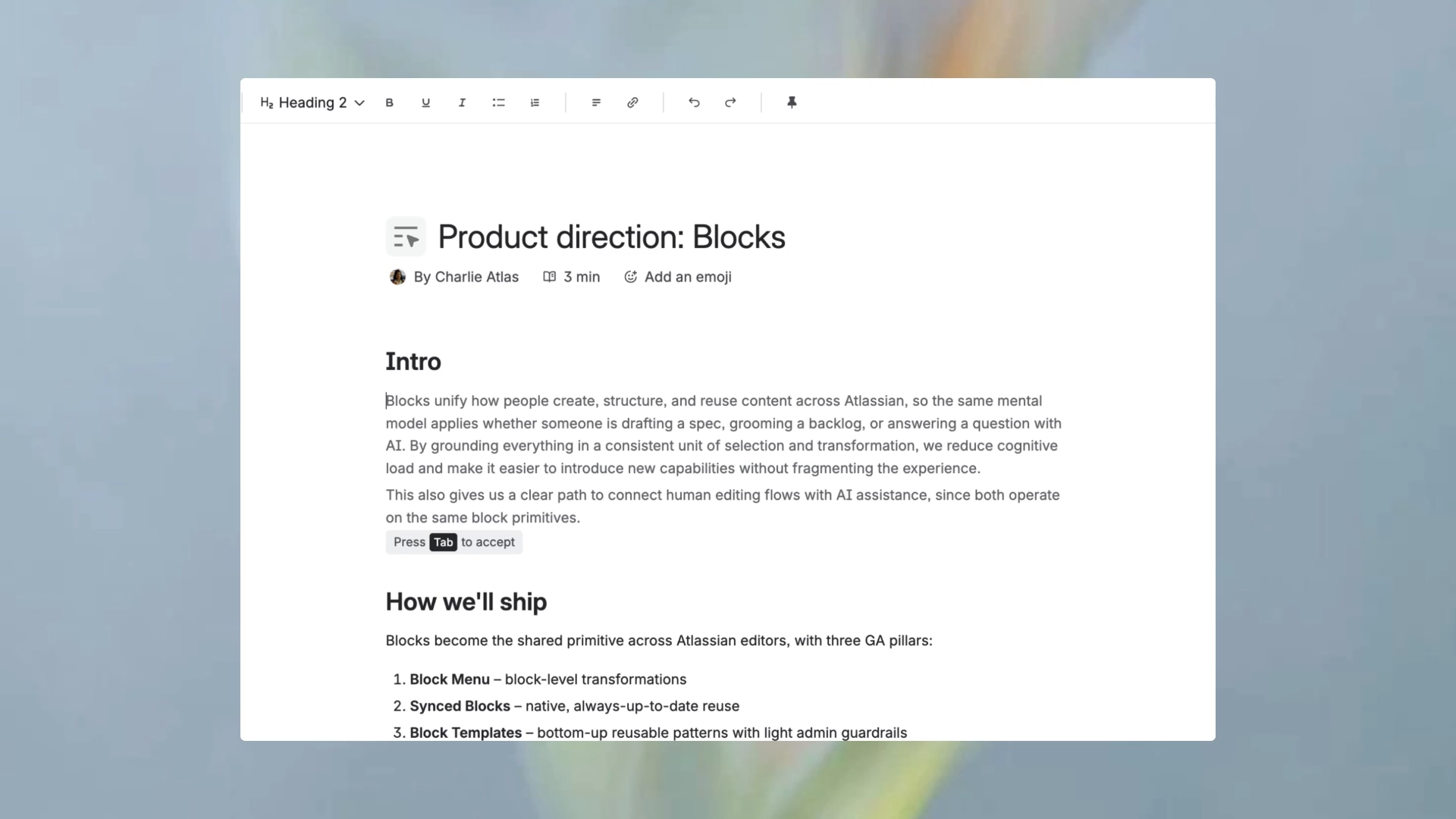
Improve Writing had shown that content expertise could move LLM quality metrics. The next question I had was: what if AI didn't wait to be asked?
Writing suggestions in Atlassian products have historically been static, requiring the user to press a button or navigate a menu item. I pitched a different model: proactive autocomplete that gives users the suggestions they need, when they need them, without them even having to ask. No new UI. No friction. Think Gmail predictive text, but for the work you do in Confluence and Jira.
To get it on the roadmap, I needed to show it, not just describe it.
I'd established a design prototyping repo for my team in Cursor, which meant I could go from idea to working prototype with real LLM calls in a live environment in a matter of hours. Less than 24 hours after pitching it in a team meeting, it was on the roadmap.
From there I led the product strategy and end-to-end design:
Watch an end-to-end walkthrough of the Autocomplete prototype in Jira and Confluence
- 1
Defined the interaction principles — the feature had to be quiet, not pushy. Give a suggestion when and where a user needs it, but allow them to easily dismiss it if it's not what they want.
- 2
Built a content heuristics framework — what should autocomplete actually say? When should it draw on page context vs. structural cues? These decisions needed to be explicit enough to encode into a prompt and backend logic.
- 3
Designed and iterated on the prompt — working with engineering, I iterated on the core system prompt to improve output quality. The difference between prompt v1 and the current version was meaningful: generic conclusions vs. contextually aware, genuinely useful suggestions.
- 4
Created a golden dataset and evaluation pipeline — using a Python script, so we could measure quality consistently as we tested each new prompt in Statsig.
The feature moved from idea to working prototype to development in weeks. It's preparing to launch this half.
A working demo with real LLM calls was able to align cross-functional stakeholders and get a feature from concept to roadmap in record time. Off the back of this, I started leading workshops with the broader design team: getting everyone set up on Cursor, introducing concepts like git and local development, and turning "pitch to prototype" into a repeatable model across the team.